
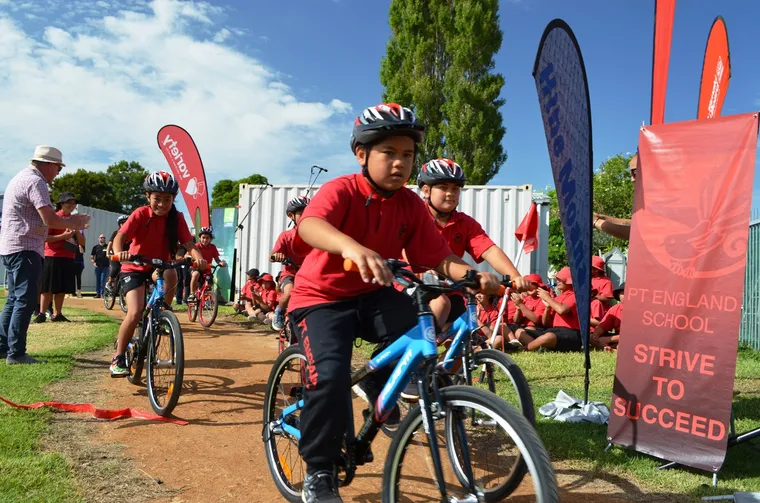
What is Bikes in Schools?
Bikes in Schools is a complete biking package built right into a school: bikes, helmets, tracks, secure storage, and cycle skills training, all on-site, so every child gets to ride during the school day, not just the kids who already have a bike at home.
The school owns everything: the bikes, the helmets, the tracks, the storage. We offer free, hands-on advice on project managing, funding, and getting it all built, to any school or council in New Zealand keen to get started.
A typical package includes:
- A fleet of 30 to 50 quality bikes, usually across four sizes
- A good-quality helmet for every child
- A riding track, pump track, skills track, or some combination of the three
- Secure bike storage, where it’s needed
- Introductory cycle skills training to cover the riding and safety basics
Some councils and providers run complementary programmes worth pairing this with, like Travelwise Safe School Travel Plans in Auckland, or Pedal Ready in Wellington.
Why it matters
Kiwi kids are biking a lot less than they used to. Between 1990 and 2014, the average time New Zealand 5 to 12 year olds spent biking dropped from 28 minutes a week to just 4. Distance biked fell from 2.8km a week to 0.5km. (Source: Ministry of Transport NZ Household Travel Survey.)
Bikes in Schools changes that fast. Regular access to a bike goes from around 30% of students to 100%, and that shift is both immediate and easy to measure.
Principals, teachers, parents, and cycle skills providers report the same things again and again: more confident, resilient kids; health and wellbeing gains; a chance for students to manage a bit of risk safely; and a habit of riding that often follows kids and their families well beyond the school gates. Several independent studies back this up.
What the research says
Eastern Institute of Technology (2013)
The EIT tracked three schools over two years through testing, surveys, and focus groups with parents and teachers. Three key findings:
- Parents and teachers across all three schools maintained a high level of engagement in the project. Teachers continued to incorporate Bikes in Schools into the 2012 curriculum.
- Teachers reported many physical benefits including increased physical fitness, motor skills, and coordination. The data showed an increase in estimated VO₂max (a measure of aerobic fitness).
- Data demonstrated that the percentage of obese children dropped from 2011 to 2012, against the national trend, which saw childhood obesity increase by 2% from 2006/7 to 2011/12.
Mackie Research: ACC evaluations (2018 & 2019)
Mackie Research conducted evaluations commissioned and funded by ACC. The 2018 Preliminary Report: Fun, Active, Safe & Social (PDF) provided preliminary findings, recommendations, and school snapshots.
The 2019 final report expanded on these findings. Two handy handouts came from this work:
ViaStrada: Palmerston North City Council (2017)
ViaStrada Consultants completed a detailed Bikes in Schools Programme Assessment (PDF) for the Palmerston North City Council, which resulted in the council confirming funding for additional schools. As reported in the local media, “So far, six schools are part of the programme, which has been hailed a success in a review by consultants ViaStrada, with more than 1600 children now riding more often, with better skills, and health benefits.”
Porirua City Council (2020)
In December 2020, Porirua City Council released Riding Easy: Porirua Bikes in Schools Story (PDF), written by Louise Thornley for the Porirua Bikes in Schools network.
What we recommend schools do
We recommend that all schools review the above information, particularly the two-page Recommendations for Schools handout. This contains valuable information that will help schools maximise the outcomes from their Bikes in Schools projects.
Why it works
- Every child benefits. Not just the ones who already have a bike.
- Kids want it. Bikes are an easy sell to students.
- It’s complete. Everything’s on-site, ready to go.
- It needs little from teachers. Low organisational overhead once running.
- It’s good value. Around $400 per child to set up, roughly $120,000 for a typical school.
How to plan your project
Every project is different, but most schools work through the same steps. Each one links to the part of the guide that covers it.
- Get your school behind it. Talk to your principal, teachers, Board of Trustees, and parents, and decide who will lead the project. Visiting a nearby school that already has tracks is the quickest way to bring people on board. Find one on the map.
- Work out what you need and get quotes. Work out how many bikes and helmets suit your roll, which tracks fit your grounds, and whether you need bike storage. Ask the suppliers listed in this guide for quotes, then get extra quotes from local bike shops and suppliers, including the cost of ongoing servicing.
- Get Board approval and line up your funding. Confirm Board of Trustees approval before any fundraising starts. Most funders want a letter confirming Board support and a minuted resolution covering where, who, and how much you’re applying for. Funding usually comes from several sources rather than one grant. See Costs and funding.
- Build the tracks. Where you can, wait until all or most of the funding is confirmed, so contractors can be on-site together and share equipment. Get a BMX club or professional track builder in for the pump track, and an experienced provider for the skills track. See Bike tracks.
- Order bikes, helmets, and storage. If you’re getting a shipping container, check the delivery truck can reach the spot where it will sit. Talk to your track builder and bike supplier together before the pump track is built, so it suits the bikes you’ll be riding.
- Book cycle skills training. Contact your local provider (usually your council, a Regional Sports Trust, or local Police) in advance, so training runs from the day the tracks open. See Cycle skills training.
- Hold your opening and keep it going. Most schools mark the finished project with an official opening and use it to thank their funders. Set aside around $3,000 a year from your operational budget for bike and track maintenance, and show funders you’ve done so.
What an opening event looks like
Most schools launch their Bikes in Schools project with an official opening. Usually, it involves special guests such as the local Mayor, MP, or a famous sportsperson to open it. Parents, the local community, and local media (and sometimes national) are always invited. Each school puts their own style onto the event.
Some schools put out a simple press release about the event detailing the different funders.
Schools also use the opening to publicly thank the funders and supporters who have helped make the project a reality. The opening event at every school has also led to positive press coverage and publicity for each school. Often the schools have an acknowledgement / thank you sign to publicly thank all funders for contributing to their Bikes in Schools project.
See our Media page for examples of media coverage of opening events.